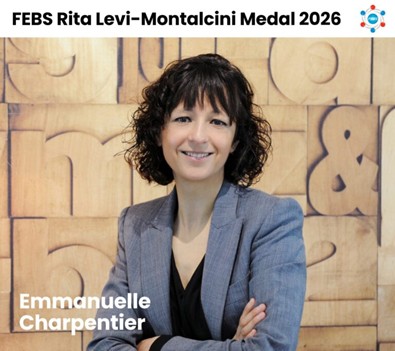




For many years, FEBS has awarded three medals for outstanding achievements in biochemistry and molecular biology or related sciences to distinguished senior scientists – the Sir Hans Krebs medal (since 1968), the Datta medal (since 1986) and the Theodor Bücher medal (since 1999) – with the awardees delivering key plenary lectures at the FEBS Congress. These medals, initiated with funds donated by other parties, commemorate the names of individuals who made important contributions to the early development of biochemistry and/or of FEBS.
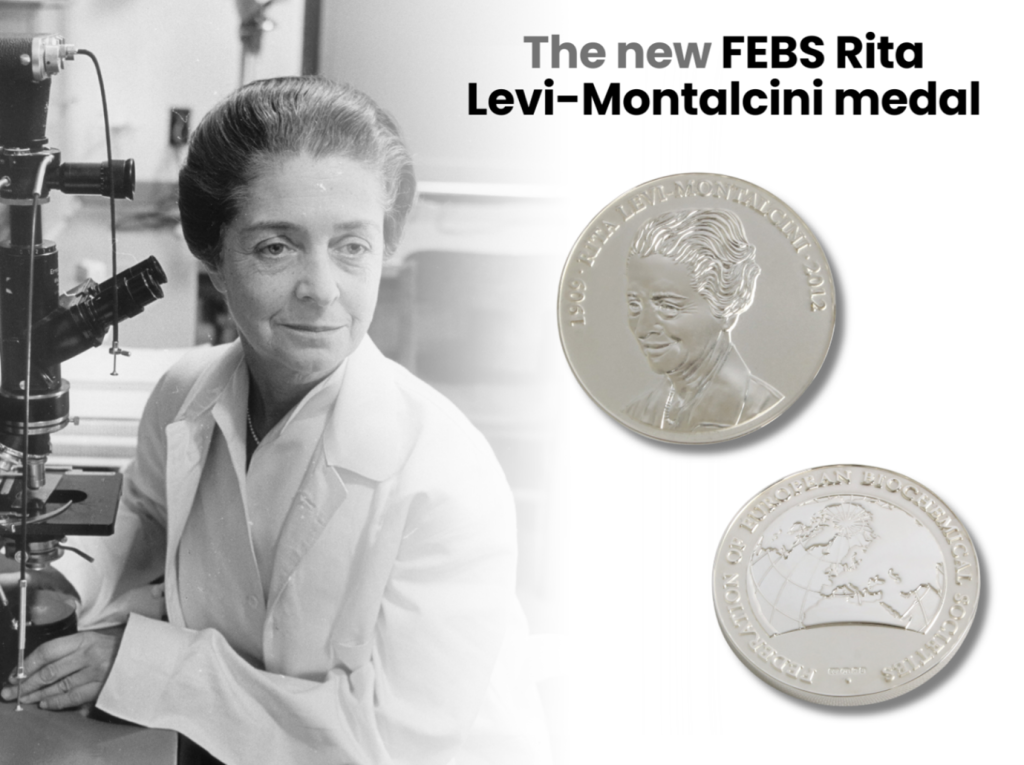
Starting at the 50th FEBS Congress, FEBS is delighted to announce that a new medal with an associated Congress plenary lecture will join the award portfolio of FEBS, this time named in honour of an inspiring female researcher of the past: Rita Levi-Montalcini (1909–2012). The FEBS Rita Levi-Montalcini medal will be awarded for outstanding achievements in biochemistry and molecular biology or related areas, with an emphasis on work on the molecular basis of disease or treatment. The recipient will be a researcher of any gender who is active in European research and resident in Europe and/or a FEBS country. The medal and lecturer travel/accommodation expenses at a FEBS Congress are funded by FEBS.
Johannes Buchner (FEBS Publications Committee Chair) and Mauro Maccarrone (FEBS Advanced Courses Committee Chair), the two proposers of the new medal, say, “We felt it important for FEBS to honour a distinguished female scientist in the suite of named FEBS medals. Rita Levi-Montalcini stands out not only for her ground-breaking research work leading to the discovery of ‘nerve growth factor’ but also for her determination in overcoming prejudice early in her career, and for inspiring and supporting young people, women and minorities in scientific education and research, which fits the objectives of FEBS.”
FEBS Congress Counsellor Graça Soveral adds, “The milestone 50th FEBS Congress – when we reflect back and look to the future – is an excellent moment to introduce a new FEBS medal. We are very pleased to be able to award the first FEBS Rita Levi-Montalcini medal to Emmanuelle Charpentier. Her lab’s work on the CRISPR-Cas9 adaptive immune system in bacterial species laid the foundation for the development of powerful genome editing and engineering technology that has not only revolutionized life science research but has opened up pathways for gene therapy.”
“This is a very welcome extension to the range of FEBS awards aiming to celebrate achievement and inspire,” commented FEBS Secretary General Miguel A. De la Rosa. “I look forward to seeing the first Rita Levi-Montalcini medal presented at the 50th FEBS Congress to Emmanuelle Charpentier and hearing her medal lecture.”
About Rita Levi-Montalcini
Rita Levi-Montalcini was born in 1909 in Turin, Italy to Italian Jewish parents. She overcame limited expectations for women in the early 20th century by graduating in Medicine and Surgery from the University of Turin Medical School and then began her specialism and research work with neuro-histologist Giuseppe Levi. However, this was cut short by the barring of ‘non-Aryan’ Italians from academic and professional careers by Mussolini in the late 1930s, leading to her setting up a secret lab in her bedroom, where she studied the growth of nerve fibres in chicken embryos. Barriers and risks continued during World War II, when, for example, she was forced to flee from work in Belgium and spent time in hiding in Florence.
In 1947, she was invited for a lab stay by neuroscientist Viktor Hamburger at Washington University School of Medicine, St Louis, USA, who had noticed her work. A short visit turned into 30 years (with appointment of full professor in 1956), with spells also back in Italy and a key research visit to Rio de Janeiro, Brazil. Further studies of nerve growth in response to mouse sarcoma tissue, and collaboration with biochemist Stanley Cohen, led eventually to the isolation of nerve growth factor (the first known growth factor) in the 1950s. Recognition of the importance of this work came with the award of the Nobel Prize in Physiology or Medicine to Rita Levi-Montalcini and Stanley Cohen in 1986.
Rita Levi-Montalcini was a director of Italian research centres of neurobiology and of cell biology in the 1960s and 1970s, and in 2002 founded the European Brain Research Institute in Rome, where she kept a keen interest until her death in 2012 at the age of 103. In 2001 she was appointed to the prestigious ‘senator for life’ political role in Italy. Through books and lectures, she became an important mentor for women scientists, and created with her twin sister Paola the ‘Fondazione Rita Levi-Montalcini’ to promote educational programmes, particularly for women in Africa.
More information
Rita Levi-Montalcini: Nobel Prize Outreach, Obituary (Cell), Levi-Montalcini Foundation
Emmanuelle Charpentier
FEBS medals
FEBS thanks Piera Levi-Montalcini for authorizing use of her aunt’s name and image for the FEBS Rita Levi-Montalcini medal.